The short version
Chiggers are larval mites that cause intensely itchy welts. Control them by treating your yard with a permethrin-based spray, keeping grass short, and using repellents. For severe infestations, professional treatment costs $100-$450.
- Chiggers are larval mites, not insects; they do not burrow into skin.
- Peak season is late spring through early fall (May-September) in the South and Midwest.
- DIY control involves mowing, clearing brush, and applying insecticides like permethrin.
- Professional treatments cost $100-$450 and often include a workmanship warranty.
- Prevention includes wearing repellent and avoiding tall grass and brush.
This guide is for homeowners, especially those with children and pets who play outdoors. If you live in or visit the southern or midwestern United States, where chiggers are most prevalent, you'll find actionable advice for both DIY and professional control. Whether you're dealing with a minor outbreak or a full-blown infestation, we've got you covered.
What to look for
Chiggers are the larvae of trombiculid mites, barely visible to the naked eye. They thrive in warm, humid environments, particularly in tall grass, brush, and shaded ground cover with high moisture. In the U.S., they are most active from late spring through early fall, with peak activity in May through September. Contrary to popular belief, chiggers do not burrow into the skin. Instead, they attach to hair follicles or skin folds, inject digestive enzymes that liquefy skin cells, and feed on the resulting slurry. This enzyme injection causes an intense, persistent itch that can last for days or even weeks.
- 1Intensely itchy red welts, often in clusters, on ankles, waist, armpits, or behind knees.
- 2Bites appearing several hours after being outdoors in grassy or brushy areas.
- 3Seeing tiny red or orange mites on clothing or skin after walking through vegetation.
- 4Pets scratching excessively after being in the yard, especially around the belly and ears.
- 5Presence of small, red, moving specks on low-lying vegetation or leaf litter.
- 6Multiple family members or pets showing similar bite patterns after outdoor activity.
- 7Bites that do not have a central puncture mark (unlike mosquito or flea bites).
Why it’s worth acting soon
- Intense scratching can lead to secondary bacterial infections like cellulitis.
- Bites can become infected, requiring medical treatment and antibiotics.
- Delayed control allows chigger populations to explode, making treatment more difficult and expensive.
- Persistent infestations may force you to avoid your own yard during peak seasons.
- Chiggers can spread to new areas via pets, clothing, or infested vegetation.
Treatment options and typical costs
DIY Liquid Insecticide Spray
$15-$40 per treatment
Apply a permethrin-based concentrate using a garden hose sprayer. Treat lawn edges, brush, and shaded areas. Reapply after rain or every 30 days.
- Time
- 30 days
- Best for
- Small to medium yards with moderate infestations
Granular Insecticide
$20-$60 per treatment
Broadcast granules containing bifenthrin or lambda-cyhalothrin across the lawn using a spreader. Water in after application. Effective for larger areas.
- Time
- 4-6 weeks
- Best for
- Large lawns and perimeter treatments
Professional Yard Treatment
$100-$450 per treatment
Licensed pest control technicians apply a combination of barrier sprays and granular treatments, often with a workmanship warranty. Includes inspection and targeted application.
- Time
- 4-6 weeks
- Best for
- Severe infestations, multi-acre properties, or when DIY fails
Prices are typical published ranges. Ask what’s included before you compare quotes.
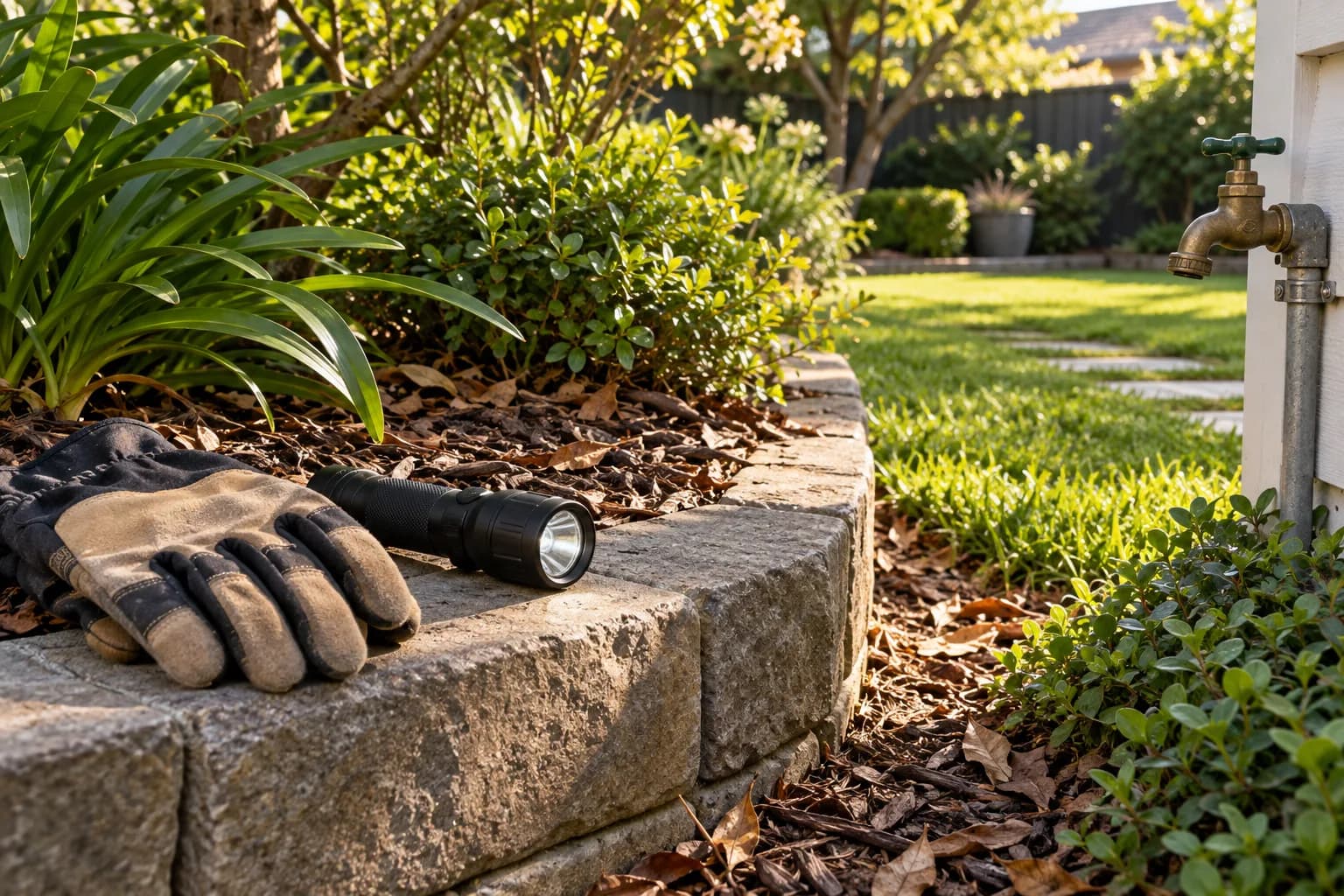 Thick, damp mulch by the house can hold chiggers. Keep it thin and let it dry out.
Understanding Chigger Biology and Behavior.
Chiggers are most active in warm, humid conditions, typically when temperatures are above 60°F (15°C) and relative humidity is high. They cannot survive in direct sunlight or dry conditions, which is why they concentrate in shaded, moist areas like tall grass, brush, and leaf litter. In the United States, they are most common in the Southeast, Midwest, and parts of the Mid-Atlantic, but they can be found as far north as the Great Lakes and as far west as the Pacific Northwest. Contrary to the persistent myth, chiggers do not burrow into or under the skin. The red welt and intense itching are caused by an allergic reaction to the enzyme injection. The feeding tube (stylostome) remains in the skin, which the body eventually rejects, but the mite itself is long gone. Understanding this biology is key to effective treatment: killing chiggers in the environment, not on the skin, is the primary control strategy. Chiggers are the larval stage of harvest mites (Trombiculidae). They are nearly microscopic, measuring only 0.15-0.3 mm, and are reddish or orange in color. After hatching, larvae climb onto low vegetation and wait for a host—typically a mammal, bird, or reptile. They are not parasitic in the traditional sense; they do not take a blood meal. Instead, they pierce the skin with their mouthparts and inject a digestive enzyme that breaks down skin cells. They then feed on the liquefied tissue for several days before dropping off to molt into nymphs.
chiggers activity by season.
In Diy Vs Professional Chigger Control, checking the foundation, gaps around doors and windows, and any moisture or clutter near the structure usually turns up the conditions that are letting them in. Scheduling before the busy stretch, rather than after it, tends to mean faster service and a more accurate quote, and a local provider can point out the conditions that matter most in Diy Vs Professional Chigger Control. The most useful first step in Diy Vs Professional Chigger Control is to note where you have seen chiggers and when they appear, because that timeline is what lets a provider focus on the right area instead of treating the whole property.
 Damp leaf piles hold moisture chiggers like. Rake them away from the house.
DIY Treatment: Step-by-Step Application Guide.
Do not apply immediately before rain; allow at least 24 hours for the insecticide to dry and adhere to plant surfaces. Granular insecticides are easier for large areas. Use a broadcast spreader to apply bifenthrin or cyfluthrin granules evenly across the lawn. Water the granules in with a sprinkler to activate them and drive them into the thatch layer where chiggers hide. Reapply every 4-6 weeks during peak season. Always wear gloves and a mask when handling insecticides, and keep children and pets off treated areas until the spray has dried or granules have been watered in. Proper timing and coverage are critical; missing even small patches can allow chiggers to persist. For homeowners tackling chiggers themselves, liquid or granular insecticides are the most effective tools. Start by identifying treatment zones: focus on lawn edges, shaded areas under trees, around gardens, and any transition zones between lawn and woods. Avoid treating flowering plants to protect pollinators. For liquid sprays, choose a product containing permethrin, bifenthrin, or lambda-cyhalothrin. Mix according to label directions and apply using a hose-end sprayer or backpack sprayer. Coverage should be thorough but not excessive—aim to wet the vegetation without runoff. Apply in the early morning or late afternoon when chiggers are most active and to minimize drift.
Professional Treatment: What to Expect and Why It Works.
The application itself is precise: technicians use calibrated equipment to ensure even coverage and avoid overapplication. A key advantage of professional service is the warranty. Companies like chigger control offer a workmanship warranty: if chiggers return between treatments, re-treatment may be available under the pro’s written terms. This peace of mind is especially valuable for families with children or pets. Prices typically range from $100 to $450 per treatment, depending on yard size and severity. Many companies also offer bundled services for mosquitoes and ticks, which can be cost-effective if you need multi-pest control. When you schedule a professional yard treatment for chiggers, a licensed technician will first conduct a thorough inspection to identify chigger hotspots. They look for tall grass, overgrown brush, moist shaded areas, and signs of animal activity that attract mites. The technician will then customize a treatment plan, often combining a liquid barrier spray with granular applications for residual control. Professional products are typically more concentrated and longer-lasting than consumer-grade options. Many companies use microencapsulated formulations that release slowly over weeks, providing extended protection. They also have access to products that are not available to the general public, such as those containing chlorfenapyr or indoxacarb.
What affects the price
- Yard size and layout (larger or more complex yards cost more).
- Severity of infestation (heavy infestations may require multiple treatments).
- Product type and application method (professional vs. DIY).
- Local pest control company rates and competition.
- Seasonal demand (prices may be higher in peak months).
- Additional services like tick or mosquito control bundled together.
📊
What is your biggest challenge with chiggers?
When to call for help
If you have a large property, a severe infestation that DIY treatments haven't resolved, or if you're unsure about proper product application, it's time to call a professional. Ask whether the inspection is credited toward the work and whether the warranty is written. them at to schedule an assessment. Pro treatments are especially valuable if you have young children or pets who spend time in the yard, as technicians can choose the safest options.
What you can do yourself
DIY treatments are cost-effective and work well for small, manageable infestations. Products like permethrin sprays or bifenthrin granules can be applied with standard equipment. However, they require careful timing, coverage, and reapplication. Professional treatments, while more expensive, provide thorough coverage, use commercial-grade products, and often come with a warranty. For persistent or widespread chigger problems, the expertise and convenience of a pro often justify the cost.
Where you live matters
Here, DIY treatments can be effective if started early, but heavy rains can wash away insecticides, requiring reapplication. In the Northeast and Pacific Northwest, chiggers are less common but still present in localized areas with tall grass and high humidity. Travelers bringing chiggers home from infested areas can also introduce them. No matter where you live, the key factors are moisture and vegetation. Keeping your yard dry and well-maintained is the first line of defense. If you live near a wooded area or a field, you may need a combination of DIY and professional treatments to create a effective barrier. Chigger activity varies significantly across the United States. In the Southeast—states like Georgia, Alabama, and the Carolinas—chiggers are a near-constant nuisance from April through October, with peak activity in June and July. The humid subtropical climate provides ideal conditions for mite reproduction. Homeowners in these regions should consider regular professional treatments as part of their routine yard maintenance. In the Midwest, including states like Missouri, Kansas, and Illinois, chiggers are also abundant but have a shorter peak season from May to September. The transition from spring to summer brings the highest risk.
Simple ways to keep chiggers away
- Keep grass mowed short (under 3 inches) and trim brush and overgrown vegetation.
- Remove leaf litter, wood piles, and other debris that provide moist hiding spots.
- Apply insect repellent containing DEET or picaridin to socks, pants, and shoes before going outside.
- Wear long pants tucked into boots and long sleeves when in grassy or wooded areas.
- Shower immediately after outdoor activity and wash clothes in hot water to remove any chiggers.
- Create a barrier of gravel or wood chips between lawn and wooded areas to discourage mites.
- Consider treating pets with veterinarian-approved tick and mite repellents.
 If you get a quote, ask which spots will be treated and how long to stay off the lawn.
Did you know?
Chiggers inject digestive enzymes that liquefy skin cells—that's what causes the intense itch, not a bite or burrowing.
The myth that chiggers burrow under the skin is completely false; they feed externally and drop off after a few days.
Only larval chiggers are parasitic; adult mites are harmless predators of small insects.
Questions people ask
What kills chiggers in the yard instantly?
Insecticides containing permethrin, bifenthrin, or lambda-cyhalothrin kill chiggers on contact and provide residual control for weeks. Apply as a liquid spray or granules to infested areas.
How long do chigger bites last?
The intense itching typically lasts 2-7 days, but the welts may remain visible for up to two weeks. Over-the-counter anti-itch creams and antihistamines can help relieve symptoms.
Can chiggers infest my house?
No, chiggers cannot survive indoors because they require high humidity and a host to feed on. They may hitch a ride on clothing or pets but will die within a day or two inside.
Will cutting the grass get rid of chiggers?
Mowing helps by reducing the habitat that chiggers prefer—tall grass and brush. However, it won't eliminate them entirely. Combine mowing with insecticide treatments for best results.
Are chiggers dangerous to pets?
Chiggers can bite pets, causing intense itching and hair loss, especially around the ears, belly, and between toes. They are not known to transmit diseases to pets, but scratching can lead to infections. Use veterinarian-recommended repellents.
How often should I treat my yard for chiggers?
During peak season, treat every 4-6 weeks with residual insecticides. After heavy rain, reapplication may be needed. Professional treatments typically include a 30-day warranty.
What is the best time of day to apply chigger control?
Early morning or late afternoon is best, when temperatures are cooler and chiggers are most active. Avoid applying in direct sunlight or before rain to ensure the product adheres and dries properly.
Can I use home remedies like bleach or alcohol to kill chiggers on my skin?
No. Home remedies like bleach, alcohol, or nail polish are ineffective and can damage skin. Instead, wash with soap and water, apply calamine lotion or an over-the-counter hydrocortisone cream, and take an antihistamine for itching.
Can chigger bites cause painful urination in kids?
They can, when bites cause swelling in the genital area. In Smith and colleagues' 1998 case series of 94 children treated for summer penile syndrome at one Midwestern U.S. emergency department, 33% had painful urination and 8% had a weakened urine stream, alongside itching in 84%. Those figures describe selected clinic patients whose cases were attributed to insect or chigger bites, not children in general. If a child has trouble urinating after outdoor play, see a doctor rather than waiting it out.
Sources (12)
The facts in this article come from the public sources listed above. Every home is different, so ask the company you talk to about pricing and what’s included. Published by Chigger Exterminator · Updated September 11, 2026 · How we write these guides